Español
 العربية
 Francés
 Русский
 Português
 Deutsch
 Italiano
 Kazakh
 Uzbek
Uzbek

Propylene oxide CAS#75-56-9
CAS Number: 75-56-9
Chemical Formula: C3H6O
Appearance: Colorless Liquid
Synonyms:
Propylene oxide, extra pure, 99.5%
Propylene oxide, pure, 99%
PROPYLENEOXIDE,REAGENT
HS Code: 2910 20 00
MOQ (Minimum Order Quantity): 1 FCL (Full Container Load)
Propylene oxide (PO) is a clear colorless volatile liquid with an ethereal odor. The industrial products are the racemic mixture for two optical isomers. It can be partially miscible with water [the solubility at 20 °C in water is 40.5% by weight; water solubility in propylene oxide is 12.8% by weight]. It can be miscible with ethanol and ethyl ether and form a binary azeotrope with dichloromethane, pentane, pentene, cyclopentane and cyclopentene.
Propylene oxide molecule contains an asymmetrical carbon atom, being able to carry out many chemical reactions. It has slightly lower chemical activity than ethylene oxide with reaction with active hydrogen (such as water, alcohols, acids, amines) containing material, with ring-opening to form diol, alcohol ether and alcohol amine. Hydrolysis reaction can generate propylene glycol with etherification reaction leading to the formation of alcohol ether. Under the action of catalyst, it can produce polyether polyol. Reaction with glycerol can generate polyether triol. It can react with carboxylic acid to generate ester. It can react with ammonia, leading to the formation of alcohol amine. It can react with hydrogen halide to generate halogenated alcohol. It can react with hydrogen sulfide to generate mercaptan formation. It can react with thiophenol to generate hydroxypropyl benzene sulfide. Under the catalysis of the trimethylamine, it can react with carbon disulfide, leading to the formation of allyl trithiocarbonate. Under the action of catalyst, it can be isomerized to generate propionaldehyde. Propylene oxide is toxic with irritating effect on skin and eyes, even at a concentration of 1%. Its vapor can cause stimulation of respiratory organs and eyes with inhaled causing the inhibition on the central nervous system. Rat oral LD50:930mg/kg. The maximum allowable concentration of the workplace is 20 × 10-6.
Propylene oxide Chemical Properties |
Melting point | -112 °C |
Boiling point | 34 °C(lit.) |
density | 0.83 g/mL at 25 °C(lit.) |
vapor density | 2 (vs air) |
vapor pressure | 29.43 psi ( 55 °C) |
refractive index | n |
Fp | −35 °F |
storage temp. | 2-8°C |
solubility | 425-450g/l |
form | Liquid |
color | Clear |
Odor | Ethereal; characteristic; sweet, alcoholyc; like natural gas. |
explosive limit | 1.9-36%(V) |
Water Solubility | 40 g/100 mL (20 ºC) |
FreezingPoint | -112.13℃ |
Merck | 14,7856 |
BRN | 79763 |
Henry's Law Constant | Not an environmentally important parameter because propylene oxide reacts rapidly with water |
Exposure limits | TLV-TWA 50 mg/m3 (20 ppm) (ACGIH), 240 mg/m3 (100 ppm) (OSHA); IDLH 2000 ppm. |
Stability: | Stable. Incompatible with acids, bases, oxidizing agents, copper, copper alloys, brass, bronze, iron, metal chlorides, peroxides and a wide variety of other materials. Reacts with compounds containing labile hydrogen. Extremely flammable - note low boiling point, low flash point and very wide explosion limits. Moisture sensitive. |
InChI | 1S/C3H6O/c1-3-2-4-3/h3H,2H2,1H3 |
InChIKey | GOOHAUXETOMSMM-UHFFFAOYSA-N |
SMILES | CC1CO1 |
LogP | 0.030 |
CAS DataBase Reference | 75-56-9(CAS DataBase Reference) |
NIST Chemistry Reference | Propylene oxide(75-56-9) |
IARC | 2B (Vol. Sup 7, 60) 1994 |
EPA Substance Registry System | Propylene oxide (75-56-9) |
Safety Information |
Hazard Codes | F+,T |
Risk Statements | 45-46-12-20/21/22-36/37/38 |
Safety Statements | 53-45 |
RIDADR | UN 1280 3/PG 1 |
WGK Germany | 3 |
RTECS | TZ2975000 |
Autoignition Temperature | 430 °C |
TSCA | TSCA listed |
HS Code | 2910 20 00 |
HazardClass | 3 |
PackingGroup | I |
Storage Class | 3 - Flammable liquids |
Hazard Classifications | Acute Tox. 3 Dermal |
Hazardous Substances Data | 75-56-9(Hazardous Substances Data) |
Toxicity | LD50 orally in rats: 1.14 g/kg (Smyth) |
IDLA | 400 ppm |
Product Application Of Propylene oxide CAS#75-56-9
Propylene oxide is used as a fumigant forfoodstuffs; as a stabilizer for fuels, heat-ing oils, and chlorinated hydrocarbons; asa fuel–air explosive in munitions; and toenhance the decay resistance of wood andparticleboard (Mallari et al. 1989). Recentstudies indicate that the fumigant potentialof propylene oxide enhances at a low pres-sure of 100 mm Hg which could render it asan alternative to methyl bromide for rapiddisinfection of commodities (Isikber et al.2004).
Factory and Equipment Show
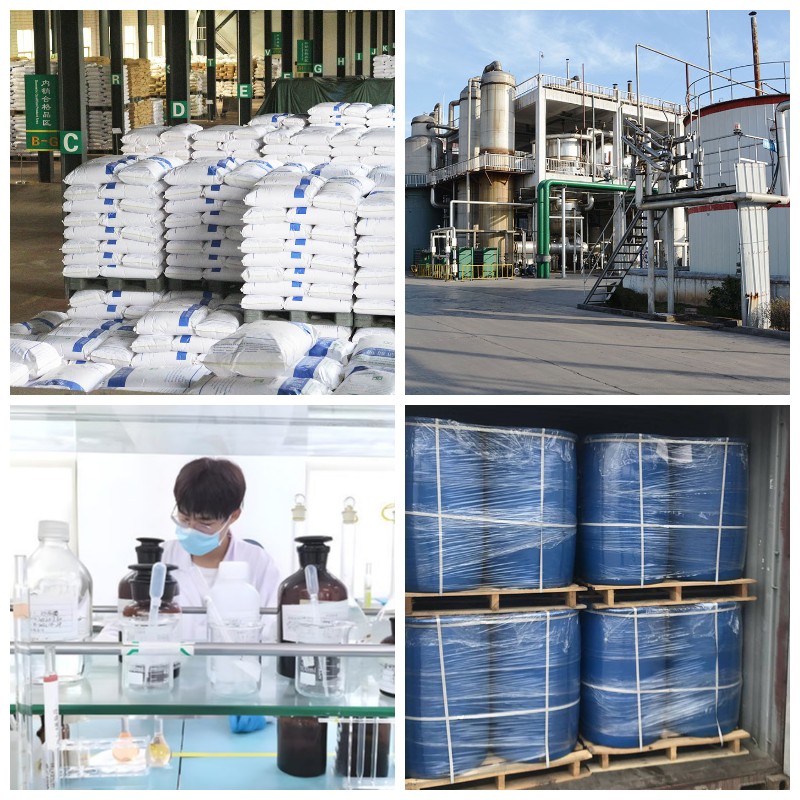
Fast delivery time
Inventory 2-3 working days New production 7-10 working days